
Coping with Eddie Coyle
Watching Peter Yates in Columbus, Ohio, at 27


My first viewing of The Friends of Eddie Coyle was an agreeable if unremarkable experience. In short, it met my expectations: a solid 70s crime drama, a low-tier gun runner (Robert Mitchum) in Boston’s criminal underworld, the compromises he makes to escape a looming prison sentence. Full of deceit and double crosses, it’s strengthened by its ground-level view of organized crime, concerned far more with the working-class realities of men who never made it to the top.
Periodically afterward the film called to me from my DVD shelf, begging for more attention and consideration. My life in at this time was defined by a change of jobs, completion of the course and thesis work for my master’s degree, and the initial wave of COVID-19 lockdowns. It felt like a different world had emerged between my first viewing in January 2020 and November 2021 when I finally sat down to try again. The second time, The Friends of Eddie Coyle played like an entirely different film.
The pandemic wasn’t an affirmation of my mortality, nor the first time I was forced to confront it. A series of family deaths that reached crescendo but not conclusion with my father’s passing just after my eighteenth birthday ensured that the reality of death would always be present. As it goes after a certain point in life, there were more deaths between the times I watched the film that were entirely unrelated to the pandemic. These influenced my mindset at the time of my rewatch.

Returning to the film unburdened by the toll of graduate studies that consumed my free time for an entire year, Peter Yates’s work unfolded like a revelation. Once the credits started to roll, I began the first nonassigned writing I had done in a year. Getting thoughts and reflections out seemed a special part of the process, both purgation and a generative means of cementing my relationship to this unassuming film.
Watched through a haze of depression, The Friends of Eddie Coyle becomes less a story about the inner workings of Boston criminals and more about a man who sees that his life is no longer in front of him. He’s spent his time working toward nothing all, his years on earth definitively closer to their end than their beginning, and in trying to escape one form of damnation, he’s ignorant of the others awaiting him. The worst thing Eddie can imagine—a three-to-five-year sentence for running bootleg whiskey—stands in the way of his actual fate.
The film offers a reminder of our place in a lonely world, one where there is no finality to any of our ends. The world keeps moving and those left behind continue to do what they need. Like everyone around him, Eddie is too proud, too hard to admit his depression and fear, and every action he takes is out of self-preservation, a sense of obligation to things entirely against his best interests. I’m no stranger to that masculine sense of determinism, the refusal to acknowledge what the problem is and how to solve it in lieu of doing everything to deter it.
One scene in the film has stuck in my mind: A bank manager dumped along the river after a successful robbery is told to count to one hundred while walking forward so his captors can escape. His blindfolded trek over the litter-strewn and unstable ground is precarious, the crooks’ actual plan unclear.
The reveal of his fate comes via an extreme long shot, the man dwarfed by the river and a barren stretch of road, safe but entirely enveloped by an order outside his comprehension. The film deals in that sense of dumb luck, whether good or bad, the irony of walking along a precipice and escaping only to find yourself in an entirely new mess. Even escape is no guarantee of security.
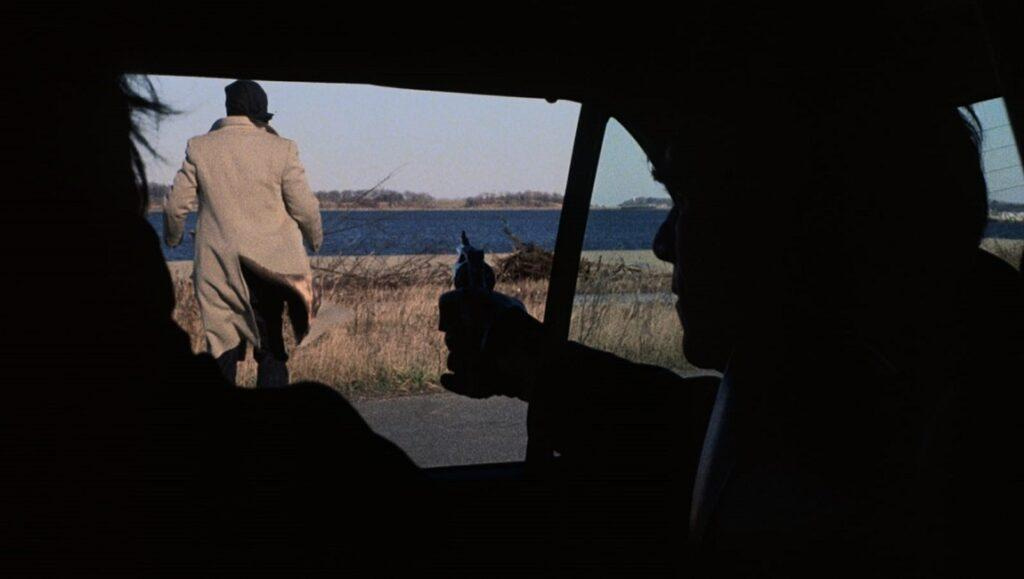
At this point, The Friends of Eddie Coyle has become a familiar companion, a work I return to the way so many others do to comfort movies. I know the film front to back, yet every time I watch it again, I still have a sense of unease as this scene unfolds.
Coyle’s demise may be certain, but it still seems that the bank manager’s fate could change at any time, as though one day he could take a step too many and plummet into the river. The Friends of Eddie Coyle is the ultimate film about death, the bargains we try to make to avoid it, and the happenstance that can lead to the end when we think we’ve covered all bases.
When scraping by every day is its own form of dying, there’s still the fear and uncertainty of an end that isn’t momentous, but quiet and undignified. Revisiting the film after all that had happened in 2020 and 2021 was a moment of enlightenment. In that span of time, with the changes in my personal life and the world at large, I learned to take comfort in the helpless inevitability of life.
In Yates’s work, I found a means of coming to terms with the greater schemes that operate with or without us, and which we sometimes find ourselves caught within. It may not be an easy comfort, but in a world that’s proven consistently unstable in the past five years, I find some measure of reassurance in its unlikely capture on film.
I need to see this ASAP. Great piece here.